Build the image from a limited stack of clean cut-paper planes with real-looking gaps between layers and one coherent light direction producing strong but soft-edged cast shadows. Big shapes only: silhouette, pose, proportions, large color areas. Below fingertip scale use only cut edges, folds and cast shadows; translate every visible surface into cut-paper shapes. Eyes and nose, where present, are cut-paper shapes with one paper-made highlight. Paper fiber and cut-edge texture visible everywhere. No photographic detail, printed outlines, photo bits or text.
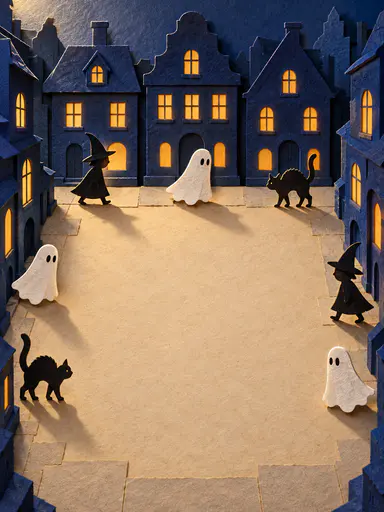
A frontal shadow-box theatre set of a night town square fills a vertical 3:4 frame, viewed straight on at eye level. A wide parchment paper square floor fills the center and lower half of the frame, completely empty — its quiet blank middle is usable copy space covering roughly two fifths of the frame. Along the top edge stands a single row of three deep-indigo paper townhouse facades with small glowing saffron paper windows; plain indigo facades also run down the left and right edges, framing the square on three sides. A sparse procession of exactly seven paper silhouettes travels these three edges — three along the top, two down the right edge, two up the left edge: three parchment-white sheet ghosts with cut-paper eye holes, two solid-black arched-back cats with upright tails, and two black pointed-hat figures with round heads. Every silhouette stands in profile and steps inward, all motion aimed at the empty center of the square.
Soft night light comes from one coherent direction above the set, casting strong but soft-edged shadows down and to the right between paper layers; the saffron windows glow gently against the indigo. The palette stays indigo, saffron, smoke blue and parchment. Every house, wall, window, floor tile and silhouette is plain and unlettered, with no numbers, letters or markings of any kind.